FILT3R

Latent State Adaptive Kalman Filter for Streaming 3D Reconstruction

1KAIST AI
ECCV 2026 (provisionally accepted)

FILT3R improves long-horizon streaming 3D reconstruction while keeping a compact recurrent state.

Abstract

Streaming 3D reconstruction maintains a persistent latent state that is updated online from incoming frames, enabling constant-memory inference. A key failure mode is the state update rule: aggressive overwrites forget useful history, while conservative updates fail to track new evidence, and both behaviors become unstable beyond the training horizon.

FILT3R addresses this by casting recurrent latent updates as stochastic state estimation in token space. It maintains a per-token variance, computes a Kalman-style gain, and estimates process noise online from EMA-normalized temporal drift of candidate tokens. The update is training-free and improves long-horizon stability for depth, camera pose, and 3D reconstruction without retraining the backbone.

Key Takeaways

  • FILT3R is a training-free plug-in state update for frozen recurrent reconstruction models.
  • Per-token uncertainty controls how much new evidence enters the persistent latent memory.
  • Adaptive Kalman-style gains reduce drift when streams exceed the training context.
  • The method keeps constant-memory streaming inference without a dense attention cache.

Method

Drift-aware process noise

Consecutive candidate tokens are compared and normalized with an EMA baseline to estimate token-wise process noise.

Variance propagation

Instead of applying a fixed overwrite rate, FILT3R carries forward latent uncertainty as evidence accumulates over the stream.

Adaptive latent gain

A Kalman-style gain determines how much of each candidate state should be integrated into persistent latent memory.
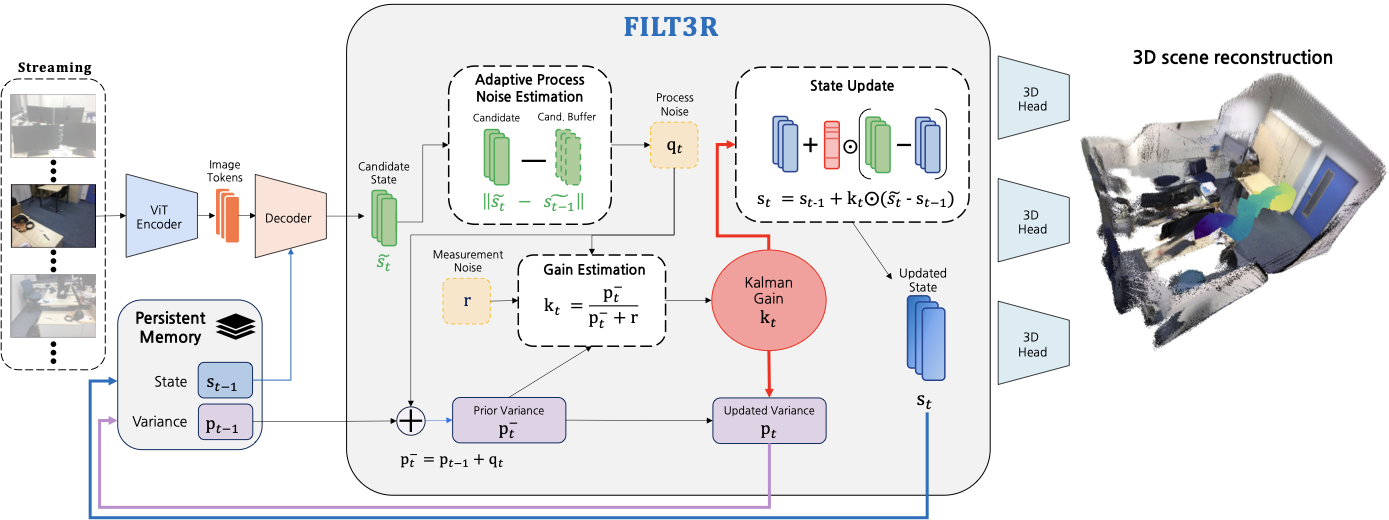
FILT3R method overview

Representative Results

Benchmark Metric Baseline FILT3R Observation
TUM-800 ATE orig TTT3R: 0.214 0.107 Long-horizon pose drift is roughly halved.
Bonn-500 Abs Rel TTT3R: 0.100 0.089 Metric depth remains stable beyond the training horizon.
Bonn-500 delta < 1.25 TTT3R: 92.1 94.4 More pixels stay within the correct metric depth band.
7-Scenes-1000 Accuracy TTT3R: 0.145 0.054 Reconstruction gains compound with rollout length.

Videos

Reconstruction highlight 1.

Reconstruction highlight 2.

Taylor update diagnostic.

TUM-800 update diagnostic.

Additional Figures

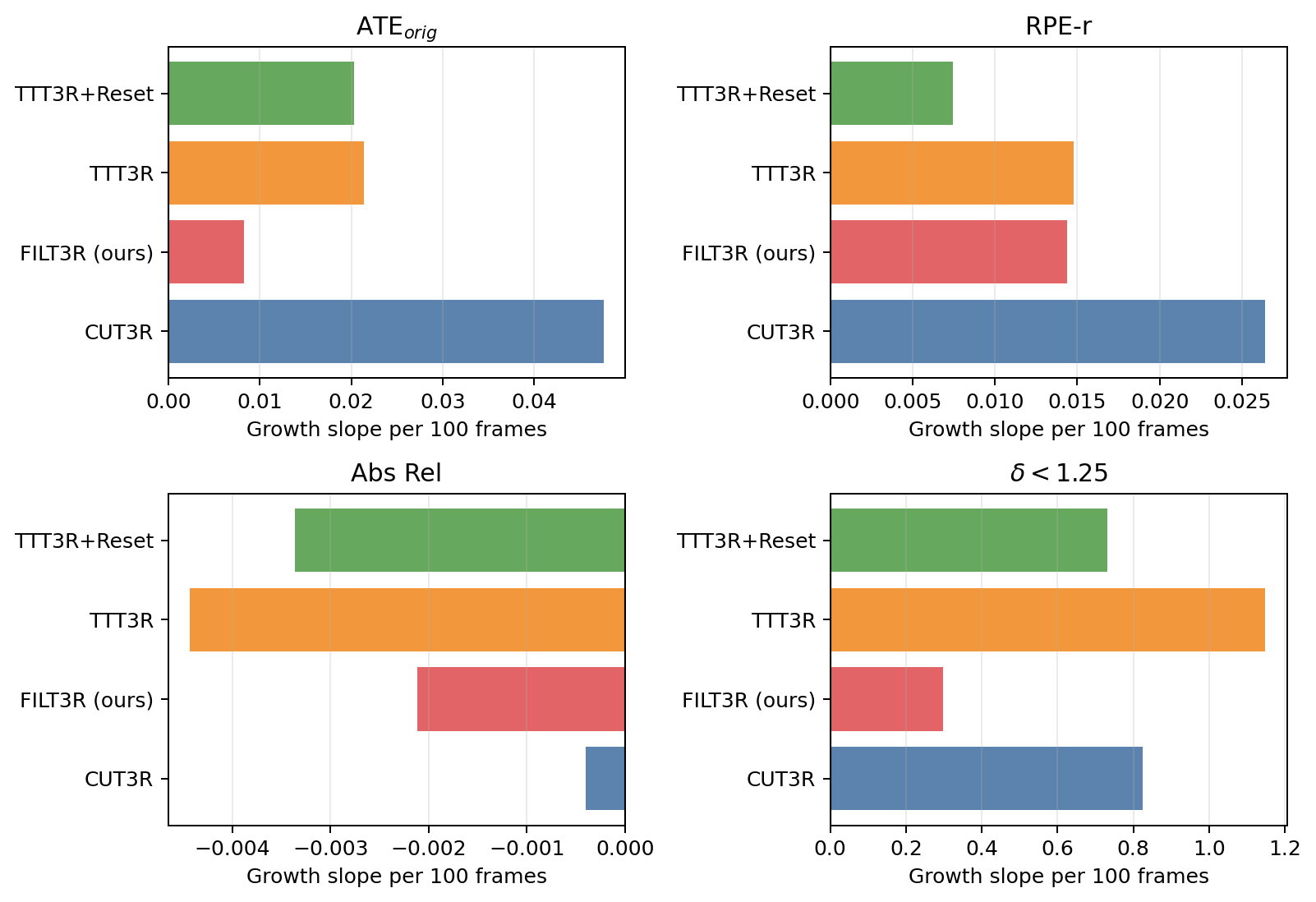
Error-growth slope summary

Error-growth slope summary.

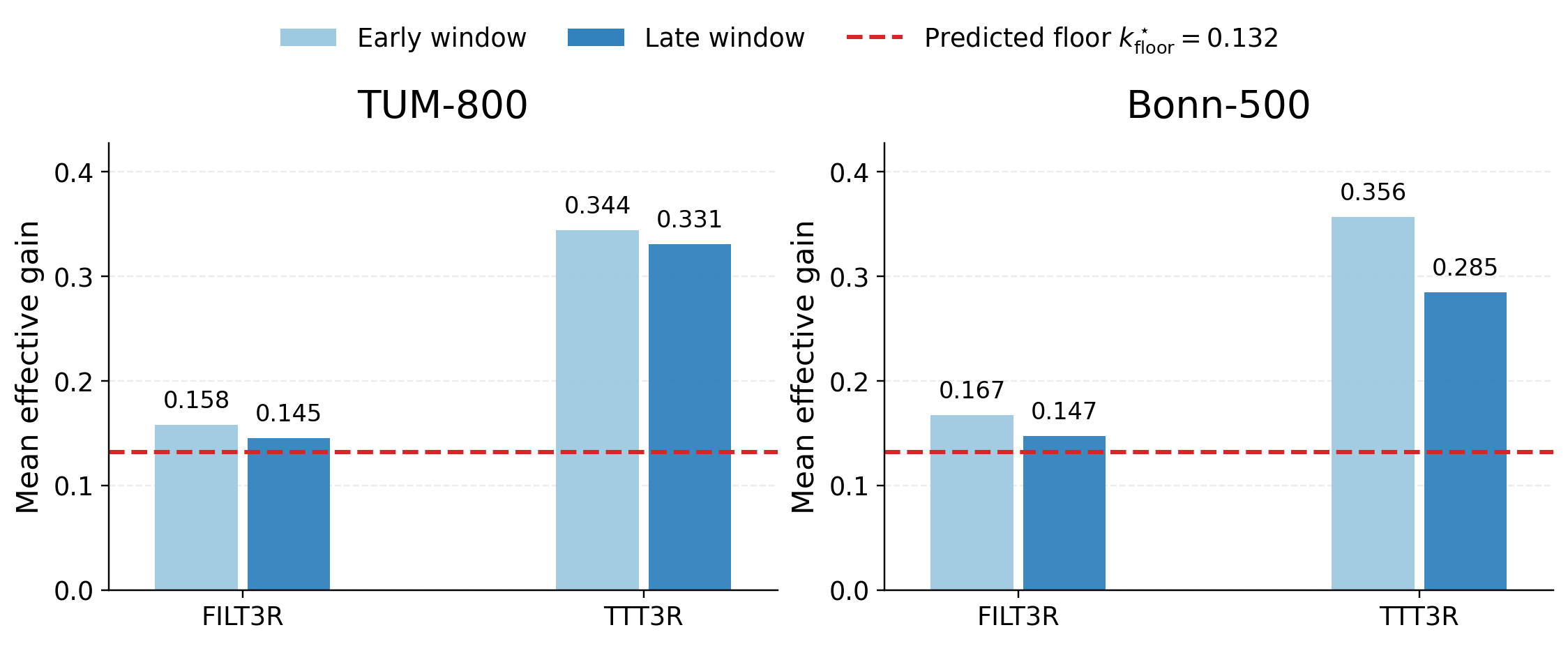
Gain-floor diagnostic

Gain-floor diagnostic.

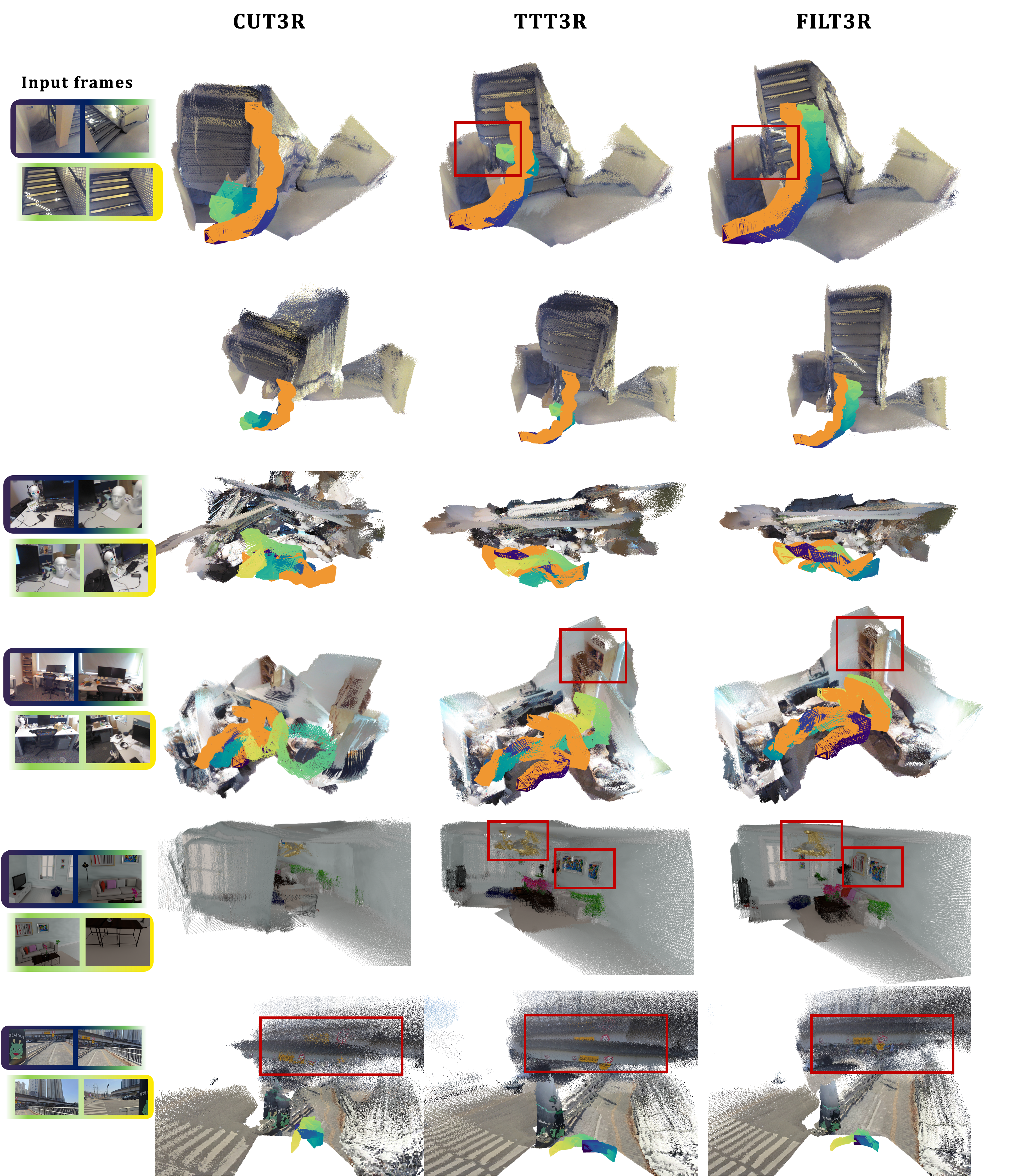
Qualitative reconstruction comparison

Qualitative reconstruction comparison over long rollouts.

Resources

arXiv

arXiv page.

Paper + Supplement

Combined PDF.

Code

GitHub repository.

BibTeX

@inproceedings{jin2026filt3r,
  title     = {FILT3R: Latent State Adaptive Kalman Filter for Streaming 3D Reconstruction},
  author    = {Jin, Seonghyun and Ye, Jong Chul},
  booktitle = {Proceedings of the European Conference on Computer Vision (ECCV)},
  year      = {2026},
  note      = {Provisionally accepted},
  eprint    = {2603.18493},
  archivePrefix = {arXiv}
}